You only owe capital gains tax when you sell something for more than you paid for it. The rates depend on how long you owned it, how much you earn, and what you sold: stocks, crypto, a home, a rental property, or collectibles. This guide covers the 2026 rates, shows how to calculate the tax step by step, and walks through real examples. If you would rather skip the math, our capital gains tax calculator does it for you.
What is capital gains tax?
A capital gain is the profit from selling an asset. You find it by taking the sale price and subtracting your cost basis, which is what you paid plus fees and any improvements. Sell for $50,000 something you bought for $30,000, and your gain is $20,000.
You are only taxed when you sell. A stock that has doubled in value but is still in your account has an unrealized gain, and that is not taxed. If you sell for less than you paid, you have a capital loss, which can offset other gains.
Short-term vs. long-term capital gains tax rates for 2026
How long you held the asset decides which rates apply:
Short-term (one year or less): taxed like your paycheck, at ordinary income rates from 10% to 37%.
Long-term (more than one year): taxed at lower rates of 0%, 15%, or 20%.
2026 long-term capital gains tax rates
The long-term rate depends on your taxable income, which is your income after deductions, and your filing status.
0% rate: taxable income up to $49,450 (single), $98,900 (married filing jointly), or $66,200 (head of household).
15% rate: taxable income up to $545,500 (single), $613,700 (married filing jointly), or $579,600 (head of household).
20% rate: taxable income above those amounts.
Married filing separately uses $49,450 for the 0% rate and $306,850 for the 15% rate.
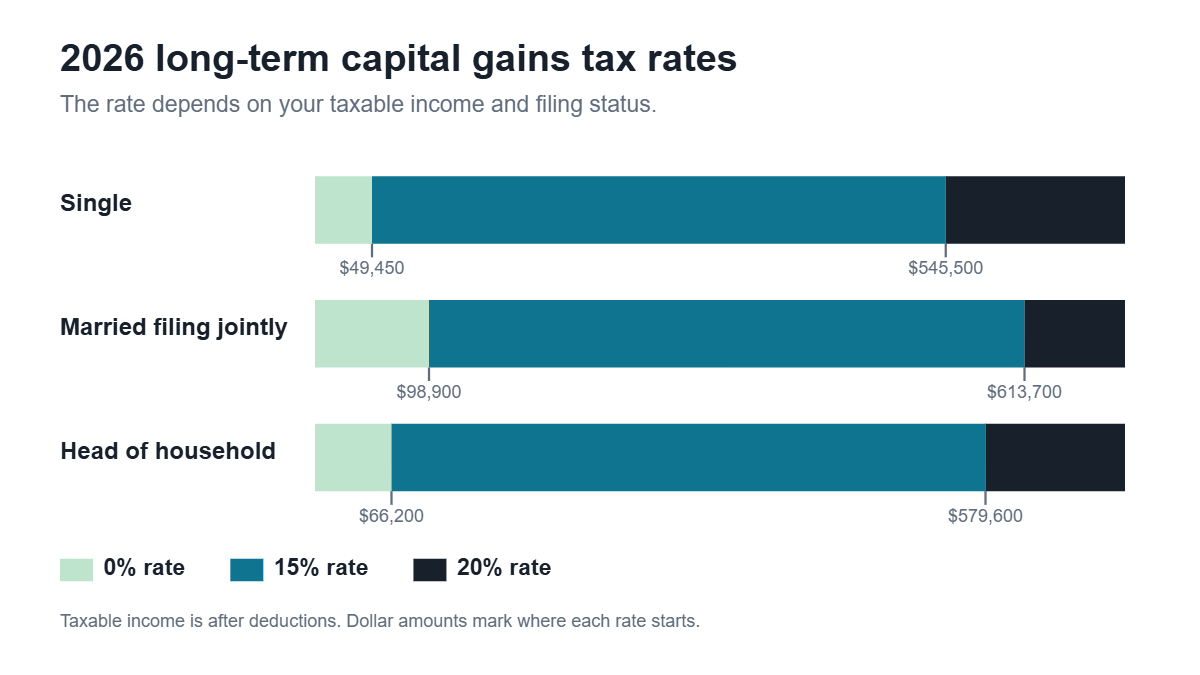
Your gain is stacked on top of your other taxable income, so a single sale can be split across two rates. If your other income leaves room in the 0% band, part of your gain may be tax-free, and the rest is taxed at 15%.
How to calculate capital gains tax, step by step
Find your cost basis. Add up what you paid, plus fees, commissions, and improvements.
Calculate your gain. Subtract the cost basis from the sale price.
Check how long you held it. One year or less is short-term. More than one year is long-term.
Work out your taxable income. Take your other income and subtract your standard deduction, which is $16,100 for a single filer in 2026.
Stack the gain on top and apply the rate. Short-term gains use your regular tax brackets. Long-term gains use the 0%, 15%, and 20% bands.
Add the extras. High earners may owe the 3.8% net investment income tax, and most states add their own tax.
Example: selling stock
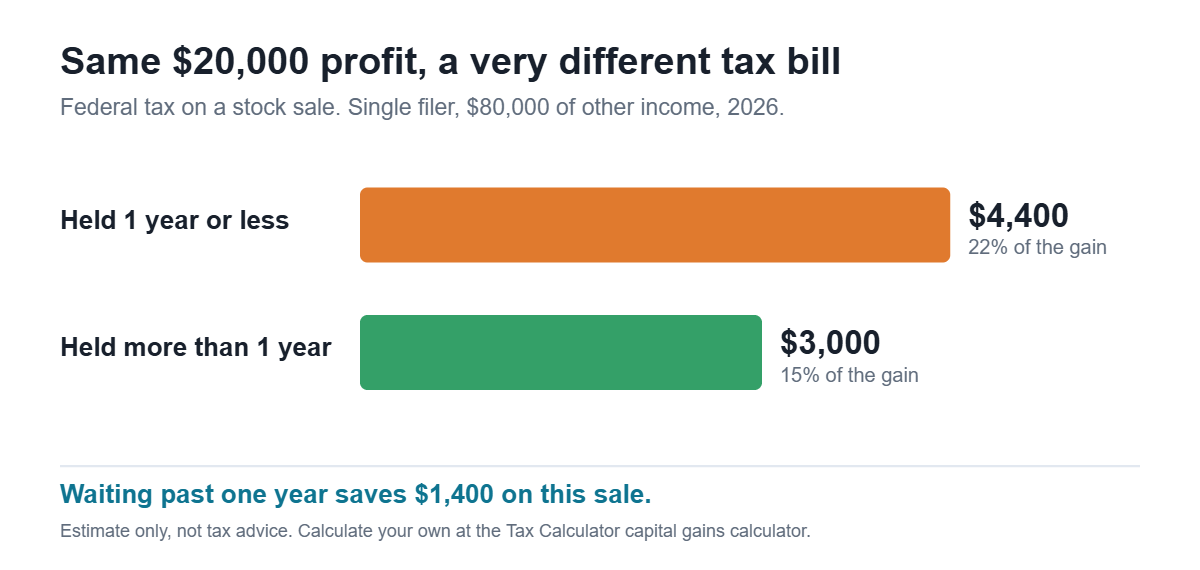
You bought shares for $30,000 and sold them for $50,000, a $20,000 gain. You are single, with $80,000 of other income. After the $16,100 standard deduction, your taxable income is $63,900, which is already above the $49,450 line for the 0% rate.
Held more than a year: the whole gain is taxed at 15%, so you owe $3,000 in federal tax.
Held a year or less: the gain lands in the 22% bracket, so you owe $4,400.
Waiting past the one-year mark saves $1,400 here. If you also live in California, the state adds about $1,860 on this sale, for a total of roughly $4,860. You can test your own numbers with the capital gains calculator for 2026.
Capital gains tax on the sale of property
Real estate follows extra rules, and the tax can be very different depending on whether you sell your home or an investment property.
Selling your home
Most homeowners owe little or no tax. If you owned and lived in the home for at least two of the last five years, and you have not used the exclusion in the last two years, you can exclude up to $250,000 of gain, or $500,000 if you are married filing jointly.
Say you sell for $750,000 a home you bought for $250,000. Your gain is $500,000. A single filer excludes $250,000 and pays tax on the other $250,000. With $80,000 of other income, that is $37,500 of federal tax at 15%, plus about $4,940 of net investment income tax, for roughly $42,440. A married couple filing jointly would exclude the whole $500,000 and owe nothing on the gain.
Selling a rental or investment property
There is no home sale exclusion on a rental. Instead, the gain is split into two parts. First, any depreciation you claimed, or could have claimed, is recaptured and taxed at your regular rate up to a maximum of 25%. Second, the rest of the gain is taxed at the 0%, 15%, or 20% long-term rates.
Say you sell a rental for $400,000, with $20,000 in selling costs. You paid $300,000 and claimed $60,000 in depreciation, so your gain is $140,000.
$60,000 of depreciation recapture is taxed at your regular rate, about $13,564.
The remaining $80,000 is taxed at 15%, or $12,000.
The 3.8% net investment income tax adds about $760.
That comes to roughly $26,324 for a single filer with $80,000 of other income, before any state tax. A 1031 exchange can defer this tax if you reinvest in another property, but it has strict deadlines, so talk to a tax professional first. To see how it works for your own sale of property, use our real estate capital gains calculator.
Crypto and collectibles
Crypto is treated as property. Selling it, trading it for another coin, or spending it are all taxable events, and the same short-term and long-term rules apply as for stocks.
Collectibles such as art, coins, stamps, wine, and precious metals are taxed at your regular rate, up to a maximum of 28%, when you have held them for more than a year.
The 3.8% net investment income tax
If your income is above $200,000 (single), $250,000 (married filing jointly), or $125,000 (married filing separately), you owe an extra 3.8% on the smaller of your investment income or the amount you are over the limit. Sell stock for a $100,000 long-term gain with $250,000 of other income, and you owe $15,000 at 15% plus $3,800 of net investment income tax, for $18,800 in total.
Capital gains tax by state, including California
Most states tax capital gains as regular income. Nine states, including Texas and Florida, have no income tax at all. Washington is one of them, but it charges a separate tax on long-term gains from stocks and similar assets above about $278,000. California has no lower rate for long-term gains, so they are taxed like wages, at up to 13.3%.
How to lower your capital gains tax
Hold for more than a year to get the lower long-term rates.
Harvest losses. Selling investments at a loss cancels out gains, and up to $3,000 of extra losses ($1,500 if married filing separately) reduces your other income. Anything left carries over to next year.
Spread big sales over several years to stay in a lower bracket and avoid the 3.8% surtax.
Donate appreciated investments instead of selling them, so you skip the gain.
Use retirement accounts. Trades inside an IRA or 401(k) are not taxed right away.
Capital gains tax FAQ
What is the capital gains tax rate for 2026?
Long-term gains are taxed at 0%, 15%, or 20%, depending on your income and filing status. Short-term gains are taxed at ordinary income rates from 10% to 37%.
Do I pay capital gains tax if I reinvest the money?
Yes. Selling triggers the tax even if you buy something else right away. The exceptions are special cases such as a 1031 exchange for real estate, or trading inside a retirement account.
Do I pay capital gains tax on the house I live in?
Often not. You can exclude up to $250,000 of gain, or $500,000 if married filing jointly, if you meet the ownership and use tests.
Is there a capital gains tax calculator?
Yes. Our free capital gains tax calculator covers stocks, crypto, a home sale, rental property, and collectibles, for both short-term and long-term gains.
This article is for general information and is not tax, legal, or financial advice. Tax rules change, so confirm your situation with a tax professional.